It’s like Planet Earth, only it was live
Pictures are up.
Our 8-day Tanzanian safari went by in a blink of an eye. We have not even left Tanzania yet and I am already reminiscing the details of those adventure-packed days. There were so many exhilarating moments, like waking up to a group of giraffes not even 100 feet from our tent, watching a cheetah chase down a gazelle, and seeing a pride of 20 lions right in front of our jeep. I know I will be reliving those moments in my head for a long time to come.
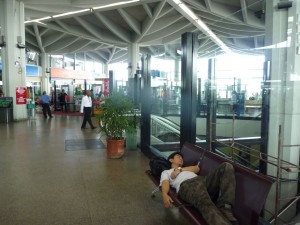
Actually, our safari didn’t quite start out the way I would have liked. It took 26 hours and 4 flights to get us from Kolkata, India to Arusha, Tanzania, with stops in Dubai, Doha, and Dar es Salaam. Our 5-hour middle-of-the-night layover in Dubai and 4-hour layover in the dinky Dar es Salaam airport were both equally miserable. Worst yet, either some food I ate or the tiredness from the long journey, or the combination of both, got me throwing up and moaning all night. I was hugging the porcelain god since 2:30AM and was completely exhausted by the time we were about to start our first day of safari. Angela was blissfully unaware of my situation and was sound asleep until about 6AM, when she offered to rub my belly in between her dozing off.
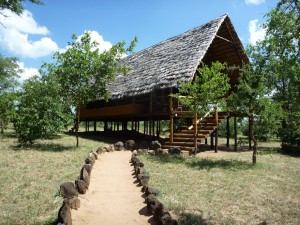
Thirsty and dehydrated, my stomach somehow refused to digest the water I drank. The water just sat in my stomach, making me feel full and bloated. I was weak and miserable. I told our safari guide Richard to just take us to the lodge so I could rest up and hopefully could start afresh on day 2. That turned out to be an excellent call. The lodging that night was at a deluxe hut situated on a hill overlooking a vast green plain. We were the only guests there that night and were treated royally. I slept and I slept and I slept. While my appetite did not come back for another 3 days, I was a new man by the next morning. We had coffee at 6:30AM on our porch before heading to the dining room for breakfast. I was ready to enjoy the safari.
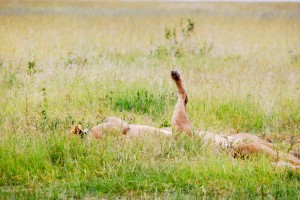
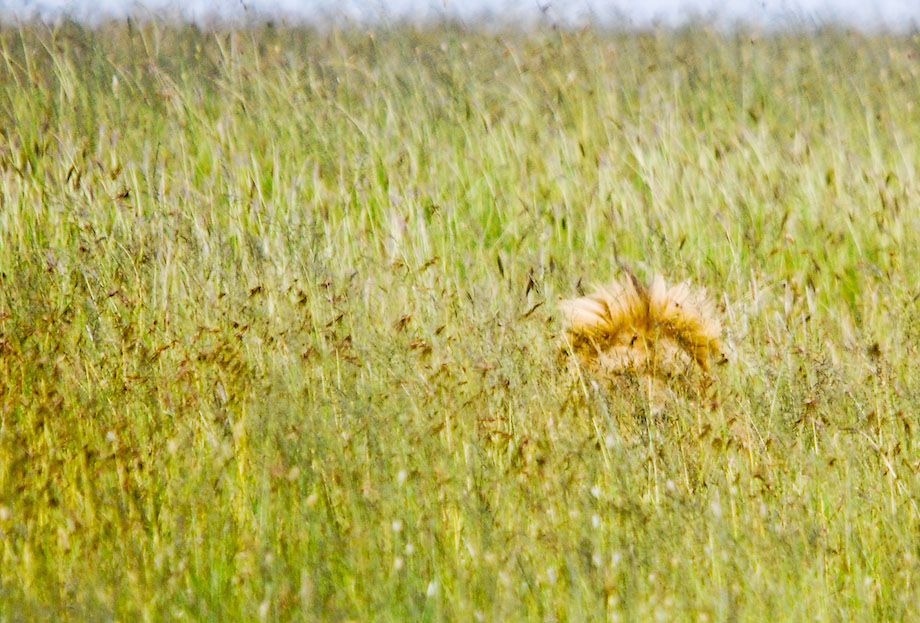
The next 6 days were like Planet Earth, only it was live. We woke up at the crack of dawn each morning, ambitioned to search for even more wildlife than we had the day before. Richard spoke only OK English, but his wildlife spotting skill was top notch. He could make out a leopard on a leafy tree just by spotting a small patch of leopard skin exposed between tree branches. We had difficulty identifying the leopard even with our binoculars and my mega zoom lens. On our first day in the Serengeti, he found us a pride of about 20 lionesses and cubs. They were alternating between basking in the sun and eating some old kill that was somewhere outside our view. While Angela and I were oohing and ahhing, he spotted a male lion in the other direction about 100 feet away. Although the lion was semi-hidden by the tall grasses that cover the Serengeti at this time of year, its mane promptly betrayed its identity, and the profile was as regal as it gets. I snatched perhaps my most favorite picture of the entire safari, shown below. I like this picture even more than those I took after we moved the jeep to just 15 feet away from the lion.
The pride of lionesses and cubs later abandoned their posts and made a bee line to a nearby rock hill. Between their original position and the rock hill was the dirt road that we were on, so they crossed the road, one by one, right in front of our eyes!
Still, seeing wildlife in a safari is not a constant event. There were definitely stretches of time in our safari when sightings were slim pickings. But I didn’t think those moments diminished the overall enjoyment. Standing up tall in the open-roof 4×4, the wind and the view of the Serengeti (meaning “the endless plain” in Swahili) was so rejuvenating that I never got tired of it. And the anticipation often made the next sighting that much more rewarding.
In a safari, the guide is the single most crucial element that affects your ultimate satisfaction. There is a lot of driving around on bumpy dirt trails in search of animals. A good guide can read paw prints and understands the natural habitat of animals. He should also know birds, which can keep you occupied when animal sightings are slow. Otherwise, he will just be going where other cars are going. Sometimes, a guide who comes across a lion or a leopard will announce such sighting on the CB radio, and immediately you will see other cars rushing in. It’s not unusual to see 5+ cars crowding over one male lion. There were certainly times when we benefited from other people’s finds, but Richard was so good that more often than not, we were the only one there or he was leading the pack.
In total, we visited 3 Tanzanian national parks and 1 conservation area. Together they make up a rather typical first-time Tanzania safari route. It is not cheap to safari in Tanzania because of the exorbitant park fees and expensive lodging. There is no such thing as cheap accommodation in these parks, as it costs a lot to run a lodge or a camp in the middle of nowhere. Rates are therefore regrettably very high. But on the flip side, quality is always excellent.
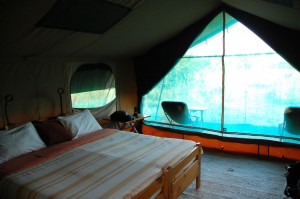
In Serengeti, our lodging of choice was what they called a luxury tented camp. Basically, we got a deluxe Campmore tent the size of an apartment. Lighting and water was very limited inside the tent, but it was furnished with a wood-frame king-size bed, a clothings rack, a sink, a shower and a seated toilet with no flush. Speaking of showers, someone actually boiled the water, mixed it with cold water, and then hauled the warm water to our tent and filled the water bag that fed into our shower.
These tented camps are not permanently located. They move 2-3 times a year with the wildlife migration in an effort to stay close to the action. This contrasts sharply with permanent lodges, which are always very well-appointed, but the setting and operation is too hotel-like and the food is usually unimaginative. We stayed at such a lodge for 1 night while in Lake Manyara National Park. The place was beautiful, with an infinity pool overlooking Lake Manyara. Still, we preferred the Serengeti tented experience as it really brought us close to nature. One morning we woke up and saw a group of giraffes cheerfully munching on the nearby acacia trees. They had to be no more than 100 feet away from us.
Food at the Serengeti Wilderness Camp (the camp’s real name) was also the best in the entire safari. Everything was freshly cooked, tasted amazing, and service was 5-star. We were again the only guests on 2 of our 3 nights there, so the 6 staff there was just servicing the 2 of us.
As I write, I am already thinking when and where our next safari will be possible. Will we come back to Tanzania? Perhaps in the winter time, which is June-August in the southern hemisphere, to catch the Great Migration of wildebeests? Or may be to Namibia, where we can drive our own 4×4 and camp on the roof of the car?
When will that be?