King Abdullah II’s Jordan
Please note: We have long left Jordan. We have since gone back to Hong Kong for Christmas and New Year and also visited Japan, India, and Tanzania. As usual, I am behind.
This place was a godsend. We left Egypt in a peak state of fatigue, frustration, and defensiveness. As a result, we mounted much skepticism and very low expectations about traveling another Arab country. Despite reading up on how much easier it is to travel in Jordan, we were still bracing for disappointment. To our relief, we arrived at the Amman airport and were immediately greeted by a refreshing sense of monarchical order and progressiveness, not to mention lots of posters of the young King Abdullah II. Not only did we find Jordanians gracious and friendly, many spoiled us with their well-spoken English. This was all evident even before we left the airport. To make things even sweeter, we had made arrangements to rent a car for the week and were looking forward to traveling all of Jordan freely and independently.
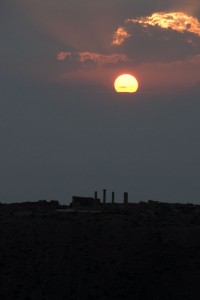
Our first stop was Madaba. It was already late afternoon. We quickly checked in to our hotel and then took off to watch the sunset over Mukawir, the site of King Herod’s palace where John the Baptist was beheaded. As I learned, John the Baptist is so-named for baptizing Jesus – yes, THE Jesus!!! Jordan proved to be quite a biblical and enlightening experience since many references of the bible can be found here. After sunset, we dropped by the Ma’in Hotsprings for a quick dip and massage. Following the locals there, I discovered that when you stand underneath the spring’s mighty thrashing waterfall, it pounds hard over your shoulders for an excellent back and shoulder massage. By the way, this is the same Madaba that is being currently referenced for housing the famous mosaic map depicting a main street running centrally thru ancient Jerusalem. This has been in the news because this same ancient center street has just been discovered, 5m underneath modern Jerusalem.
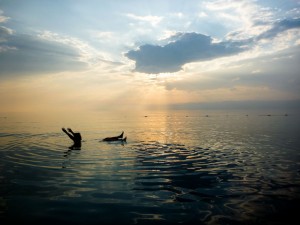
Anyways, the next day’s highlight included a tour of Mount Nebo and a dip in the Dead Sea. The Dead Sea is such a magical place for non-swimmers like myself. It is a body of water with such a high concentration of salt (over 30%) that it holds incredible buoyancy. All you do when you get in is float, whether on your back or on your belly. Even if you try to swim, all you manage to do is float.
While driving southbound towards Petra, we made a pit stop at Um al Rasa and that was quite an experience. On our guidebook, there was basically a one-liner tidbit about how this was an ancient city with a couple of churches’ mosaic tile floor maps dating back from the Byzantine era when Romans brought Christianity to what is modern day Jordan. As we pulled in to the site, the sun was just about to set and the head security guard came out to inform us that the site just closed for the day. But, for a nominal fee, he could quickly give us a guided tour of the place. So, after following his instruction to tip the night watchman $20 USD, he started leading us around like a mad man with his giant flashlight because everywhere it was getting dark. As we discovered, we were literally running because there were well over 14 churches that have been dug up and each of them contained at least one very large and very well-preserved mosaic masterpiece. Some detailed the biblical cities from Jerusalem to the Nile and others depicted local plants and animals of the time. Everywhere we saw, archaeological digs were in progress with likely even more churches waiting to be discovered. It was such a great pit stop, we didn’t even mind the extortional fee. We even tipped this man $10 for his excellent guiding.
And then, it was onwards to Petra. Historically, it was a major commerce and trading crossroads that then became obsolete and “lost” until someone discovered it in the 19th century. It is an entire city carved out of the surrounding red sandstone rocks, hills, and mountains. Many buildings can even be left standing without their columns because they are actually all one big rock.
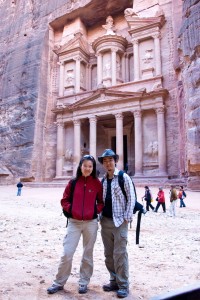
We only had one full day here and so, that morning, we were insanely (Henry more so than I) paranoid that if we weren’t the first ones there, the place would be overrun by large tour groups who would then obstruct many a-beautiful views of the place. Thankfully, it all worked out and we were one of the first groups to arrive. The moment we passed the gate, it was the beginning of nearly 9hrs of continuous hiking, walking, and climbing. Despite the fatigue and exhaustion, it was a spectacular experience and definitely well worth all the sweat. My favorites are still the Treasury and the Monastery. As we learned, much of what can be toured in Petra now is only the tip of the iceberg. There are active archaeological digs everywhere and likely so much more of Petra is still buried, waiting to be discovered.
The reason we had to rush through Petra was because we had booked a three days two nights desert safari with a Bedouin outfitter in Wadi-Rum. Much of Jordan is desert land and many of the residents belong to one of the several Bedouin tribes who have lived the nomadic life in the desert for generations.
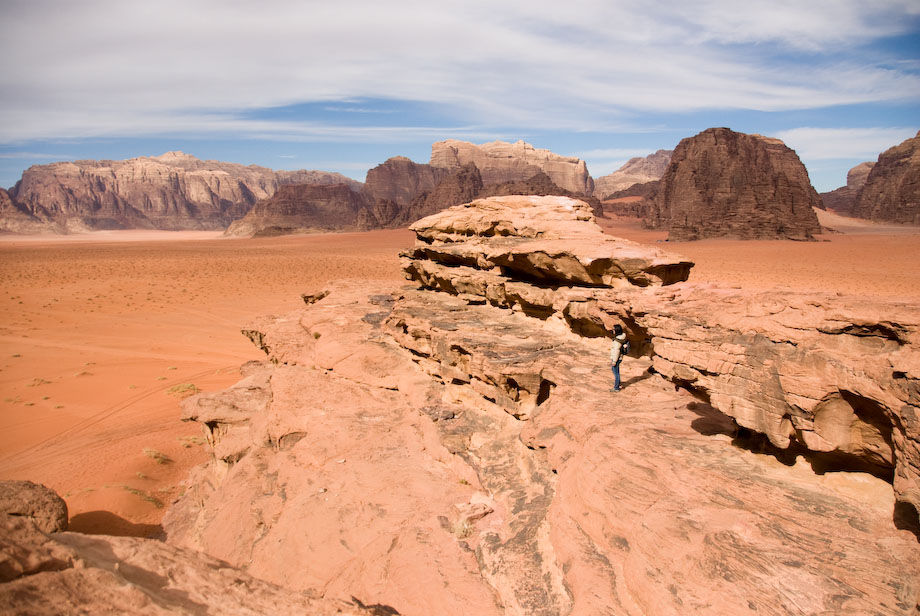
Wadi-Rum was literally dreamy. Never before could I have imagined such abrupt quiet, or the beautiful mountainous landscapes spanning across the horizon. Not to mention rolling hills of sand dunes with intermittent patches of beautiful fine, reddish sand untouched except by the gentle wind that swept through it. The large rocks were all so inviting. They were like a rock scrambler’s heaven. By day three, I was feeling quite sore since our first two days were spent touring the different attractions within Wadi-rum and hiking its many mountains. At night, we relaxed with the Bedouin guides as they told jokes over the warm campfire while drinking Bedouin tea (that’s black tea boiled with sugar). We were even able to gaze at the star lit sky both nights. Our last day was spent touring more areas of Wadi-Rum atop a camel. Having a camel’s eyeview of Wadi-rum was very cool.
King Abdullah’s Jordan was simply amazing. Who would have thought?